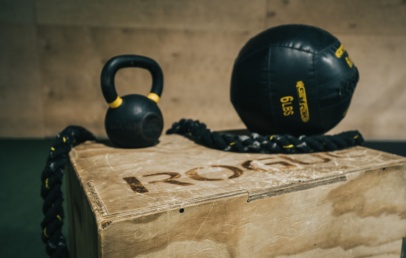
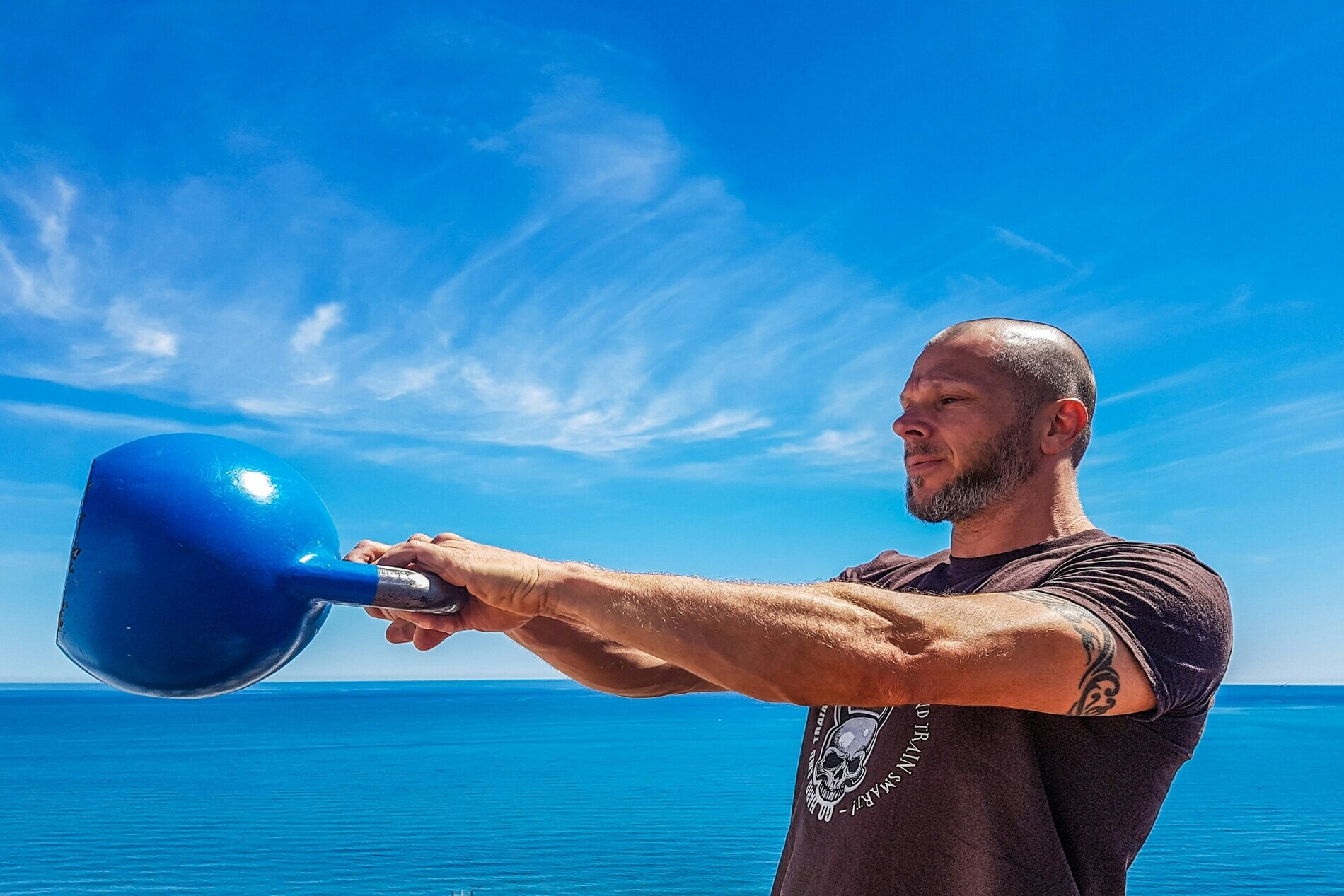
Watch someone transition seamlessly from a flawless kettlebell swing directly into a clean, a deep squat, and a smooth overhead press without stopping. It looks less like a grueling workout and more like a carefully choreographed dance with a chunk of iron.
If your current gym routine feels like a monotonous chore—sit on a machine, push a lever 10 times, scroll on your phone, and repeat—it is no wonder you are losing interest.
Your brain and muscles thrive on novelty, rhythm, and synchronization. Stringing individual movements together into a single, seamless sequence is called a kettlebell flow. It is the ultimate antidote to gym boredom, forcing your mind and body to cooperate under a ticking clock.
The Neural Magic of Fluid Movement
Traditional weightlifting trains your body in isolation, focusing on one muscle group at a time. While that is fine for building mirror muscles, it misses how your body actually moves through the real world.
A kettlebell flow forces your nervous system to fire in a continuous loop. Instead of resetting your posture between individual exercises, your core, glutes, and shoulders must constantly adjust to a shifting center of gravity. This constant spatial calculation challenges your cerebellum, building intense full-body coordination while burning up to 15% more calories than standard, stop-and-go weight training. It turns a simple iron weight into a complete cardiovascular and cognitive challenge.
The 30-Minute Coordination Flow
Grab a moderate kettlebell—one you can easily press overhead—and run through this continuous sequence. Perform each movement back-to-back, switch hands, and repeat.
- The Single-Arm Swing: Start with a standard hip hinge, driving the bell to eye level. This builds kinetic momentum and wakes up your glutes and hamstrings.
- The Clean Transition: As the bell drops from the swing, snap your elbow back and catch the weight gently against your chest in the “rack” position. Keep your wrist perfectly straight.
- The Reverse Lunge: Step backward with the leg opposite the weighted arm, dropping your back knee until it hovers 2 cm off the floor to challenge your lateral stability.
- The Press and Halo: Drive back up to standing, press the bell smoothly overhead, bring it back to your chest, and circle it around your head to open up your shoulder joints.
Pro-Tip: Check your grip tension. Beginners tend to squeeze the handle like they are hanging off a cliff, which destroys their forearms in minutes. Keep your grip loose and relaxed during the floating phases of the swing and clean, engaging your fingers fully only when catching the weight in the rack.
The 24-Hour Upgrade
You do not need to master a complex four-move sequence by tomorrow. Let’s practice the baseline transition today.
In the next 24 hours: Pick up a light kettlebell or dumbbell. Spend exactly five minutes linking just two basic movements together: perform one single-arm swing, pull it smoothly into a clean at your chest, and drop it back into a swing. Find a steady, rhythmic breathing pattern—inhale on the way down, sharp exhale on the way up. Once that feel seamless, you are ready to build the rest of your chain.