You drop onto a gym mat, clip your feet into the foot cradles of a TRX suspension trainer, and push yourself up into a plank. Within five seconds, your abs begin to quiver, your shoulders shake, and your hips start sagging toward the floor as you struggle to hold a position that feels effortless on solid ground.
It is a humbling reality check: lifting heavy iron on a stable machine does not automatically translate to real-world stability.
When you train with fixed barbells or selectorized weight stacks, the equipment stabilizes the load for you. Suspension training shifts that entire responsibility back onto your body. By using adjustable, instability-inducing straps anchored to a single point, TRX forces your deep core, rotator cuffs, and joint-stabilizing muscles to fire constantly just to keep you balanced, delivering a brutal functional workout using nothing more than your own body weight.
The Biomechanics of Leverages and Instability
The effectiveness of suspension training relies on two primary physical concepts: vector resistance and pendulum leverage.
Because the straps hang from a fixed overhead anchor point, every movement requires you to fight gravity along an unstable axis. When you perform a push-up or a row on TRX straps, your body operates as a kinetic chain. Your central nervous system must rapidly recruit small stabilizer muscles—like the serratus anterior and transverse abdominis—to control three-dimensional wobble. If you want to increase or decrease the exercise intensity, you do not need to hunt for heavier dumbbells; you simply shift your feet closer to or further from the anchor point to alter your body angle.
Core TRX Movements for Total-Body Stability
To build functional strength and bulletproof your joints, incorporate these core suspension exercises into your weekly routine:
- The Suspension Atomic Push-Up: Place your feet in the cradles, set up in a high plank, and lower your chest into a push-up. As you press back up, drive your knees toward your chest into an elevated pike to ignite your lower abdominal wall and shoulder girdles.
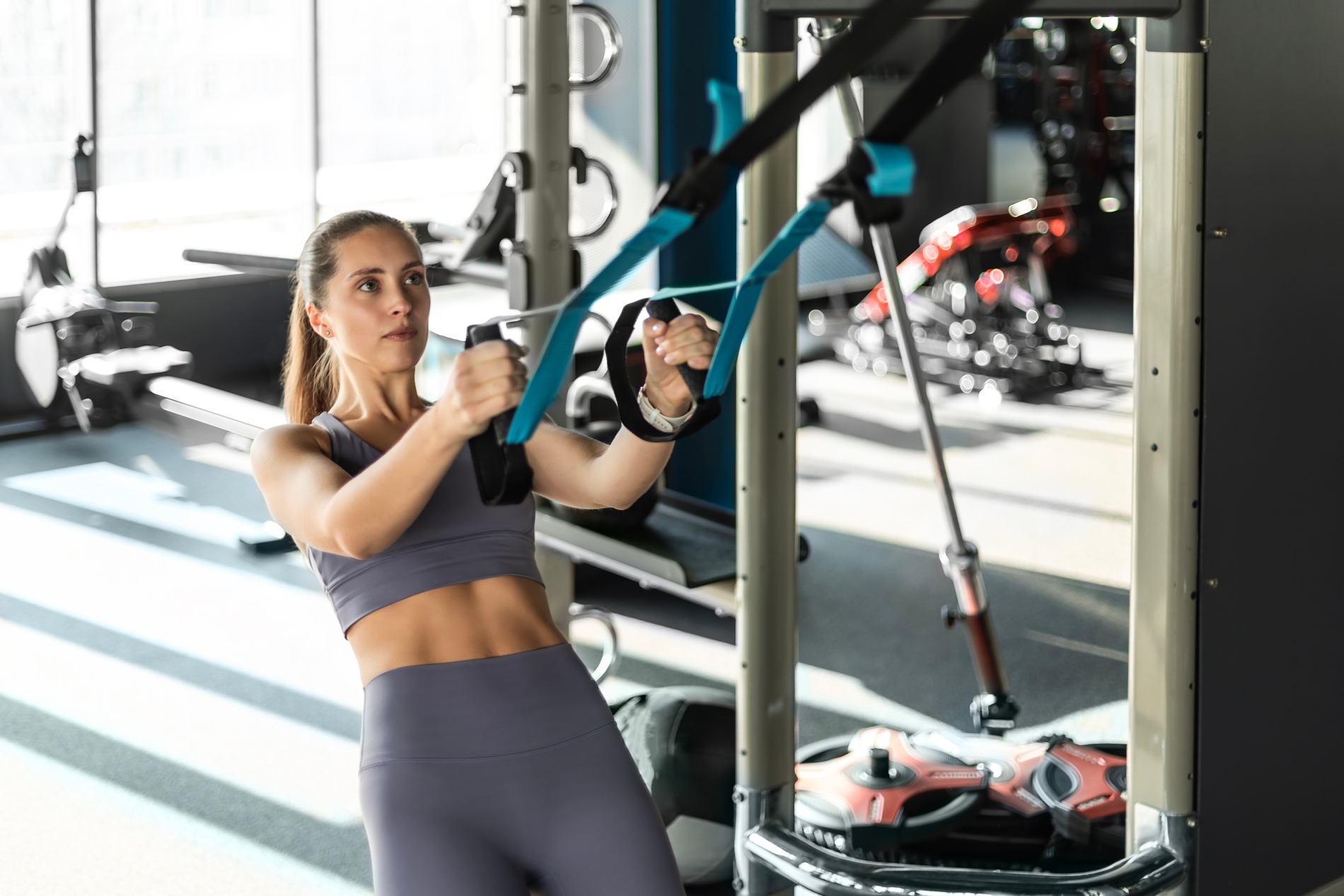
- The Suspended Low Row: Grip the handles, walk your feet forward so your body hangs at a 45-degree angle, and pull your chest toward your hands. Squeeze your shoulder blades tightly at the top to reverse desk-bound posture and strengthen your upper back.
- The Single-Leg TRX Pistol Squat: Hold the handles with light tension, elevate one leg off the floor, and sink your hips down into a single-leg squat. The straps provide just enough assistance to help you navigate full knee range-of-motion without collapsing.
- The TRX Body Saw: Set up in a forearm plank with your feet in the cradles. Slowly rock your body backward and forward 5 to 10 cm. This micro-movement dramatically increases lever length, placing an intense isometric demand on your deep core.
Pro-Tip: Never let the straps go slack. Maintain constant tension on the webbing throughout every single rep. If the straps sag at the top or bottom of a movement, you lose kinetic resistance and transfer stress directly into your joint capsules rather than keeping it on active muscle tissue.
Your First Step: The 24-Hour Upgrade
You do not need an entire hour-long class to feel the core-activating benefits of suspension training. Let’s execute one quick stability test over the next 24 hours.
During your next gym session: Find a TRX suspension trainer, set the straps to mid-length, and perform three 30-second TRX forearm plank holds. Keep your ribs pulled down, squeeze your glutes hard, and focus on keeping the straps dead still. Notice how much harder your entire core works compared to a standard floor plank—and make suspension straps a permanent staple in your workout arsenal.