There is a specific kind of ego-death that happens when a guy who deadlifts four plates gets absolutely humbled by a 20-minute mat Pilates session. You can have the kind of six-pack that shows through a heavy cotton t-shirt, but if your deep stability muscles aren’t firing, you’re essentially trying to fire a cannon from a canoe. Most of us treat core training as a vanity project, but Joseph Pilates—a cigar-smoking, boxer-turned-icon—originally designed this system to rehab soldiers in hospital beds. It was never meant to be “delicate”; it was meant to be structural.
Most traditional gym movements focus on the “global” muscles—the ones you can see. Pilates targets the “local” stabilizers, specifically the Transverse Abdominis (your internal weight belt) and the pelvic floor. For men, a strong pelvic floor isn’t just about preventing “old man” issues like bladder leaks; it’s the basement of your core. When this base is stable, your squats feel heavier, your running gait becomes more efficient, and that “tweaky” lower back pain that usually follows a weekend of yard work suddenly vanishes.
The Essentials of “Man-Lates”
You don’t need a specialized machine or a room full of mirrors to start. The goal is to move with a level of precision that makes basic movements feel incredibly difficult.
- The Hundred (Modified): Lie on your back, legs in a “tabletop” position (knees bent at 90 degrees). Lift your head and shoulders, and pump your arms vigorously by your sides while taking five short breaths in and five short breaths out. The challenge isn’t the pumping; it’s keeping your lower back glued to the floor.
- The Leg Circle: Lay flat with one leg extended toward the ceiling. Draw a circle the size of a dinner plate in the air. The catch? Your hips must remain absolutely still. If your pelvis is rocking, you aren’t using your core; you’re just swinging your leg.
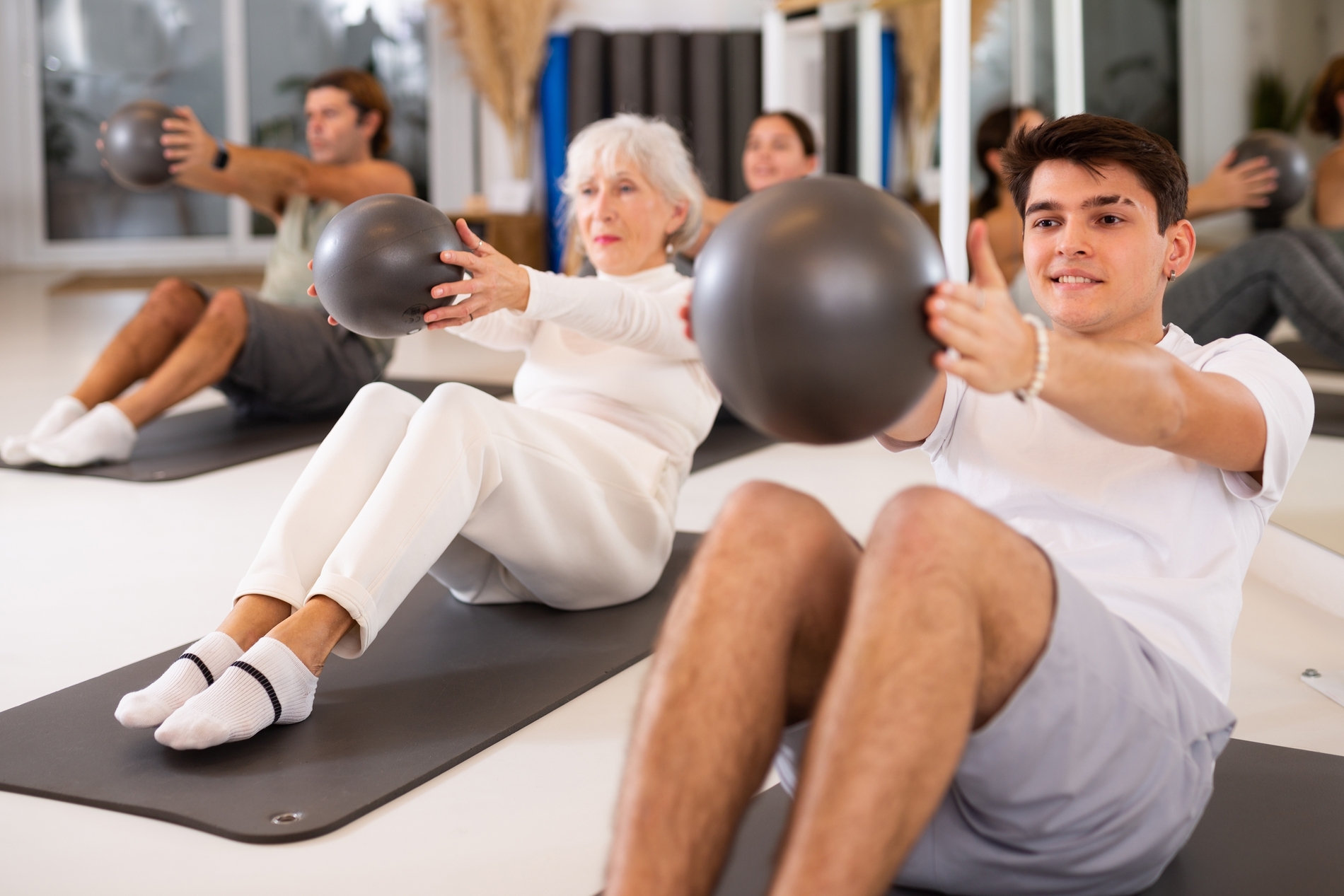
- The Pelvic Bridge with a Squeeze: As you lift your hips into a bridge, place a small ball or a rolled-up towel between your knees and squeeze. This “wakes up” the adductors, which are neurologically linked to your pelvic floor.
- Bird-Dog with a Pause: From all fours, extend the opposite arm and leg. Instead of rushing, hold the extension for five seconds while pulling your belly button toward your spine.
Pro-Tip: Forget about “sucking it in.” In Pilates, you want to think about “zipping up.” Imagine you’re trying to pull a tight pair of jeans over your hip bones. That subtle, upward lift is exactly how you engage the deep pelvic floor without holding your breath.
Your First Step
To see the difference in your structural strength, you need to feel the muscles you’ve been ignoring.
In the next 24 hours, perform the “Zipped-Up” Plank. Get into a standard forearm plank, but before you start the clock, perform the “jeans-zipping” move mentioned above and squeeze your glutes at 50% tension. Hold this for just 30 seconds. If you’re doing it correctly, those 30 seconds will feel more intense than a standard two-minute “vanity” plank. Integrate this one-move reset into your morning routine, and you’ll start building a core that actually supports the heavy lifting of real life.